Three NASA frames show the same Martian terrain over 25 seconds. The dark, branched mark appears only in the last image.
By PAI
Aug. 28, 2026
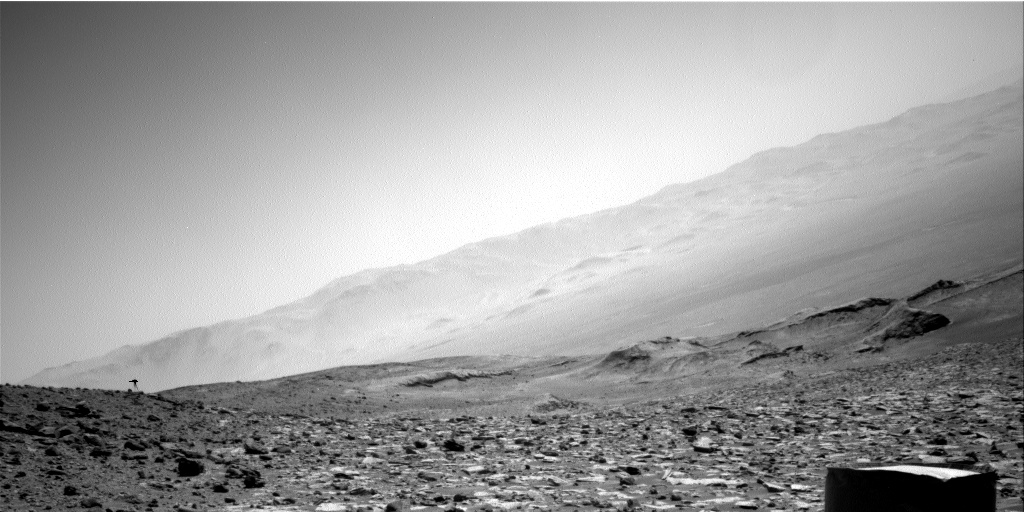
NASA’s Curiosity rover captured this right navigation-camera image on Aug. 20, 2023. A small dark mark appears near the far-left horizon. Credit: NASA/JPL-Caltech.
A dark shape in a NASA image from Mars has drawn renewed attention online because it resembles a hovering jellyfish or a three-legged machine. The available evidence, however, points to a brief camera or image-processing artifact rather than an object in the Martian landscape.
NASA’s public record shows that the Curiosity rover captured the grayscale image with its right navigation camera on Aug. 20, 2023, the mission’s 3,924th Martian day, or sol. The frame was recorded at 22:27:46 UTC and released as a 1,024-by-512-pixel JPEG preview. The dark, branched mark sits near the far-left edge, just above a low ridge.1
The strongest evidence comes from two additional NASA frames of the same scene. Curiosity used the same camera to take one image 13 seconds earlier and another 25 seconds earlier. Neither contains the mark.2 3
Three frames, one brief mark
| NASA image record | Capture time on Aug. 20, 2023 | Dark mark visible |
|---|---|---|
| 1250384 | 22:27:21 UTC | No |
| 1250385 | 22:27:33 UTC | No |
| 1250462 | 22:27:46 UTC | Yes |
The image resurfaced on social media in August 2026, nearly three years after Curiosity transmitted it. Recent reports have described the feature as roughly 15 pixels across and cited a cosmic-ray strike as the leading explanation, while also noting that an electronic, transmission or processing fault could produce a one-frame anomaly.4 5
A cosmic ray is a high-energy particle that can strike a digital camera’s light-sensitive detector. NASA says a direct hit may affect one pixel, while a particle entering at an angle can affect a line of pixels and create a streak. The particles may originate from the sun or from distant astronomical sources, including supernovas and quasars.6
Curiosity operates in an environment with less natural radiation shielding than Earth. Mars has no global magnetic field to deflect energetic particles, and its atmosphere is much thinner than Earth’s. NASA says those conditions provide only minimal protection from solar particles and galactic cosmic rays at the Martian surface.7
Similar artifacts are documented
Cosmic-ray artifacts are not unusual in spacecraft images. In 2014, Justin Maki, an imaging scientist at NASA’s Jet Propulsion Laboratory and leader of the team that built and operates Curiosity’s navigation cameras, said the mission received images containing unexplained bright spots nearly every week. The leading explanations were cosmic-ray strikes on a detector or sunlight reflecting from rocks.8
“In the thousands of images we’ve received from Curiosity, we see ones with bright spots nearly every week,” Maki said. “These can be caused by cosmic-ray hits or sunlight glinting from rock surfaces, as the most likely explanations.”8
The dark appearance of the 2023 mark does not rule out a particle strike. JPL documented a separate black artifact in the 17th frame of a Curiosity rear hazard-camera sequence recorded in November 2023. The laboratory said that artifact resulted from a cosmic ray hitting the camera sensor.9
The timing also weighs against a fixed feature on the ground. Rocks, rover hardware and stable geological formations would be expected to remain visible in successive images from nearly the same viewpoint. A distant moving object, airborne dust or another short-lived physical event cannot be excluded solely from the three public previews, but no second camera view or other independent measurement cited in the reports corroborates such an event.4 5
What the public image can establish
NASA’s archive identifies the frame as a Curiosity image, but not every mark in a digital image represents a physical object. Such images are measurements made by detectors and electronics. Particle strikes, sensor behavior, onboard processing, data transmission and ground processing can affect individual pixels.
NASA also cautions that the JPEG and PNG files posted in its raw-image galleries are compressed preview products. They are useful for an early look at mission data, but the compression removes information and generally makes the files unsuitable for detailed scientific measurement. Researchers use archival-quality files, richer metadata and calibration procedures to distinguish scene content from instrument effects.6
The public NASA page for image 1250462 identifies the camera, sol, site, drive number, timestamp, dimensions and credit. It does not identify the dark mark or assign it a cause.1 The cosmic-ray interpretation is a leading explanation supported by the mark’s pixel-scale appearance, its absence from adjacent frames and documented precedents, rather than a cause assigned in NASA’s public image record.4 5
Curiosity’s broader mission is to determine whether Mars once had environmental conditions capable of supporting microbial life. NASA says the rover has found chemical and mineral evidence of past habitable environments and continues to study the planet’s rock record.10 The single-frame mark does not provide evidence of present-day Martian life. The apparent “jellyfish” is uncorroborated, and the available record most strongly supports a momentary imaging artifact.